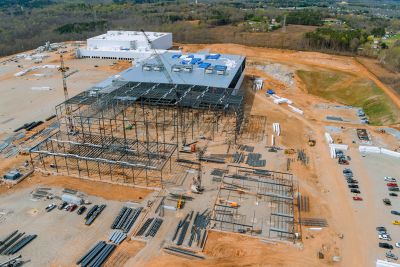
It all started when our balanced site wasn’t balanced. The earthwork kind. We looked down at a hole that had to be filled, with no dirt lef t on site to fill it. And no time left to go find any. Everyone involved, from design to estimating to project management, did everything right. Almost. Here is how it went down.
The site was a large scale data center with multiple underground stormwater detention systems. The design first came in with a precast concrete system, which is quite common. The design was sound. The system worked. The only problem was the price tag.
Equally common was the reaction. The owner almost had a stroke when the bid came in.
And so estimating did what estimating does best. It suggested a switch to a less expensive plastic system. And back to the drawing board it went.
The new design was a 60-inch round HDPE pipe system. It seemed like a logical move. The pipe itself cost a fraction of the concrete system, and installation was simpler. Unfortunately, large diameter pipe has an appetite for stone. By the time the required stone envelope was accounted for, much of the anticipated savings had disappeared.
Naturally, the owner was not pleased with the second round bid. And back to the drawing board it went.
After multiple rounds of closing the gap between design and estimating, the owner said yes to a modular plastic geocellular system. The engineer liked the design. The owner liked the number. Estimating liked the budget. Everyone finally got the answer they had been looking for.
While the system was being installed, as designed and as estimated, the damage was happening elsewhere on the site. Excavating the concrete system would have produced more earth spoils, and those spoils had a destination, a low area at the other end of the site that had been graded to receive them. The pipe system, with its appetite for stone, would have produced even more. Every cubic yard of stone that goes into a hole pushes a cubic yard of dirt out of it. The geocellular system, with modules tightly stacked, stores water in a structure that is mostly void, so it needs a much smaller hole.
Smaller hole. Less spoil.
Each successful redesign quietly moved the site off balance. The last one left the low area wide open, waiting for imported material.
Imported fill does not arrive at spoils prices. Ideally, the import is matched with an export site within a reasonable distance. That takes planning and coordination, which typically happens before a shovel hits the ground. The mid-build surprise forced a decision. We could wait and plan, but on a fast-track schedule waiting was not a viable option. And so we bought the material from a nearby quarry, at full price. Defending the schedule was never a question. The material still had to be trucked to the site before it was placed and compacted. Scrambling to organize sufficient trucking became its own schedule problem. The cost of importing the missing material consumed the savings created by the final redesign.
On large scale data center builds, enormous volumes of earth are moving in the background of aggressive fast-track scheduling. Much of what supports a data center lives in the ground, putting the dirt at the center of the schedule. Equipment deliveries keep moving forward. They don’t care that there is still a hole in the ground. A delay in the dirt does not stay in the dirt.
A planned imbalance is a line item. An unforeseen one is a schedule failure. And a schedule failure can break a data center build.
Each redesign was carefully evaluated on its own merits. What never changed was the assumption that the site’s earthwork balance remained intact.
Here we were with the least expensive system that wasn’t. The engineer designed three systems, and every one of them worked. Estimating priced every component of each detention system, and those numbers were right every time. The detention system was a winner. The site was not. Every discipline optimized its piece of the project. Nobody optimized the project itself.
A site is one continuous earthwork problem divided into bid items. Change one bid item, and you’ve changed the earthwork analysis. Whether it’s a deeper structure, a wider footing, or a different pipe, each changes what comes out of the ground and where it has to go.
Had this project been an export site, where excess material was already leaving the property, the outcome might have been entirely different. Reducing the excavation could have reduced hauling and disposal costs, making the redesign an even greater success. On this site, however, the project depended on those excavated spoils to balance the grading. The same redesign that creates value on one site can quietly destroy it on another.
The site had been balanced once. Until it wasn’t.
About the author: Rifka Malik is a civil and sitework advisor with more than 20 years of experience in heavy civil and large scale infrastructure. Her work focuses on earthwork analysis, constructability, value engineering, and the cost consequences of design decisions across the site.
For more information visit http://www.sitework-estimating.com