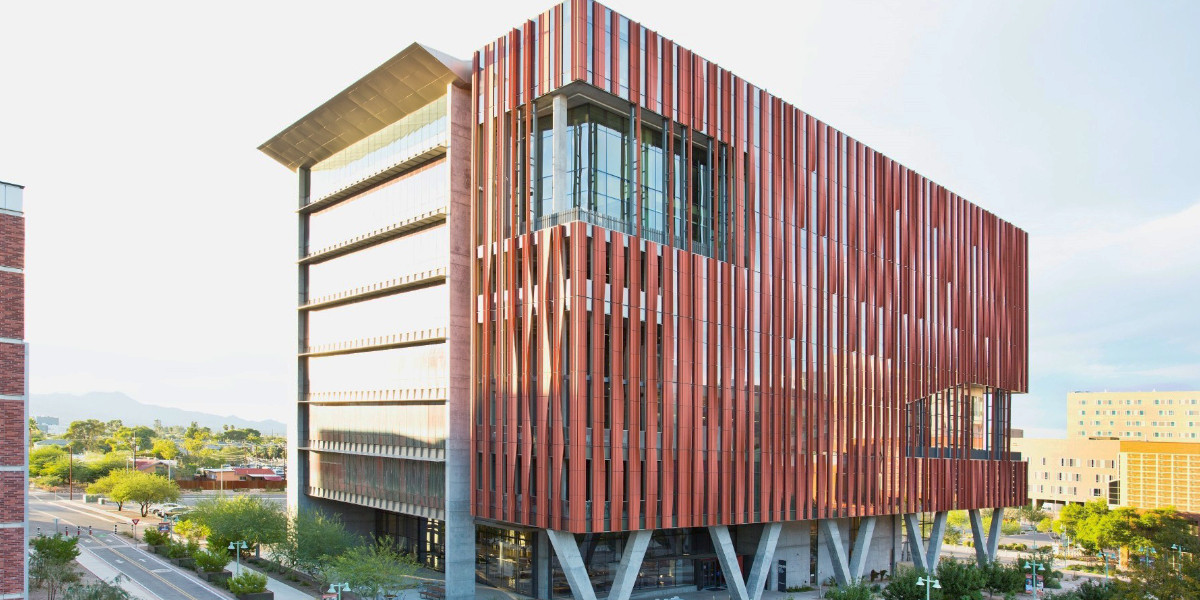
Solarban® 90 Starphire® glass highlights the Health Sciences Innovation Building (HSIB) at the University of Arizona, which meets performance, cost, availability and aesthetic goals.
Photo Courtesy: Tom Kessler
Vitro Architectural Glass (formerly PPG Glass) is marking 60 years of evolution and innovation of Solarban® glass, the flagship brand for one of the industry’s most environmentally advanced lines of solar control, low-emissivity (low-e) glasses. Solarban® glass, one of the earliest coated energy-efficient glass brands, has driven the sustainable building movement with significant energy savings and transparency. This has enabled architects and designers to achieve and exceed eco-friendly design goals.
Introduced in 1964, Solarban® glass was a pioneer among coated glasses designed to deflect heat from buildings. Its innovative design improved occupant comfort, reduced utility expenses related to HVAC systems and laid the foundation for sustainable design and construction.
Over the past six decades, Solarban® glass and its precursors have been at the forefront of multiple groundbreaking advancements, continuously reshaping architectural glass performance. In the 1980s and early 1990s, single-silver and double-silver glasses were introduced, which helped enhance year-round comfort in homes and buildings while saving on heating and cooling costs. In 2000, the world was introduced to the first double-silver vacuum temperable low-e glass that allowed for post-manufacturing fabrication, Solarban® 60 glass.

The LEED® Gold, sleek seven-story Watershed in Seattle, Washington, features Solarban® 60 glass by Vitro. The 2023 COTE® Top Ten award-winning facility is pursuing Seattle’s aggressive Living Building Pilot Program (LBPP) certification.
Photo Courtesy: Built Work Photography, LLC
The world’s first triple-silver low-e glass, Solarban® 70 glass (formerly Solarban® 70XL glass), was introduced at Greenbuild in 2005 and rapidly became the most commonly specified triple-silver low-e coated glass in the industry, with more than 700 million square feet shipped since its inception. In 2015, the first-ever quad-silver low-e glass, Solarban® 90 glass, was introduced as Vitro’s highest-performing solar control low-e coating.
“Solarban® glass has continually pushed the limits of energy capabilities and clarity, achieving advancements never before seen and becoming one of the industry’s most advanced, proven and trusted solar control low-e glasses specified for countless projects worldwide,” said Martin Bracamonte, Vitro Architectural Glass Senior Vice President of Innovation. “With Solarban® glass, building owners can confidently expect significant savings on their energy bills while providing a comfortable and visually appealing environment for occupants.”
Since its inception, the Solarban® family of products has been continually expanded and refined to meet the aesthetic and energy efficiency demands of architects and building owners. Today, the Solarban® glass family includes many high-performance solar control low-e options that increase energy efficiency, reduce building operating costs and elevate aesthetics.

Solarban® 70 glass by Vitro elevates solar control and aesthetics at 510 Vermont in Los Angeles.
Photo Courtesy: Tom Kessler
Solarban® glass products feature some of the highest light-to-solar gain (LSG) ratios in the industry. They can be combined with other Vitro glass options like VacuMax™ Vacuum Insulating Glass (VIG), Sungate ThermL™ glass, Starphire Ultra Clear® glass, Acuity® glass, Optiblue® glass and a range of tinted glasses for even better performance and aesthetic effects.
To learn more about Solarban® glass and how it can help achieve your design objectives, visit vitroglazings.com/solarban/.
For more information about other Vitro Architectural Glass products, visit www.vitroglazings.com.
About Vitro Architectural Glass: Vitro Architectural Glass, part of Vitro, S.A.B. de C.V. (BMV: VITROA), is the largest glass producer in the Western Hemisphere, manufacturing a range of industry-leading, energy-efficient, high-performance products such as Solarban®, Sungate® and Starphire Ultra-Clear® glasses. Committed to continually raising the industry standard for sustainability, Vitro was the first U.S. glass manufacturer to have its entire collection of architectural glass products earn Cradle to Cradle Certified® status and the first North American manufacturer to publish third-party verified Environmental Product Declarations (EPDs) for flat glass and processed glass products. Additionally, as of April 2024, all Vitro architectural glass products meet the Top 20% Low Embodied Carbon (LEC) material Global Warming Potential (GWP) threshold the U.S. General Services Administration (GSA) established pursuant to the Inflation Reduction Act of 2022 and related guidance from the U.S. Environmental Protection Agency. Vitro operates seven glass production facilities across North America, four residential glass fabrication plants in Canada and one of the world’s largest glass research and development facilities in Pittsburgh, Pennsylvania. For more information, please visit VitroGlazings.com.