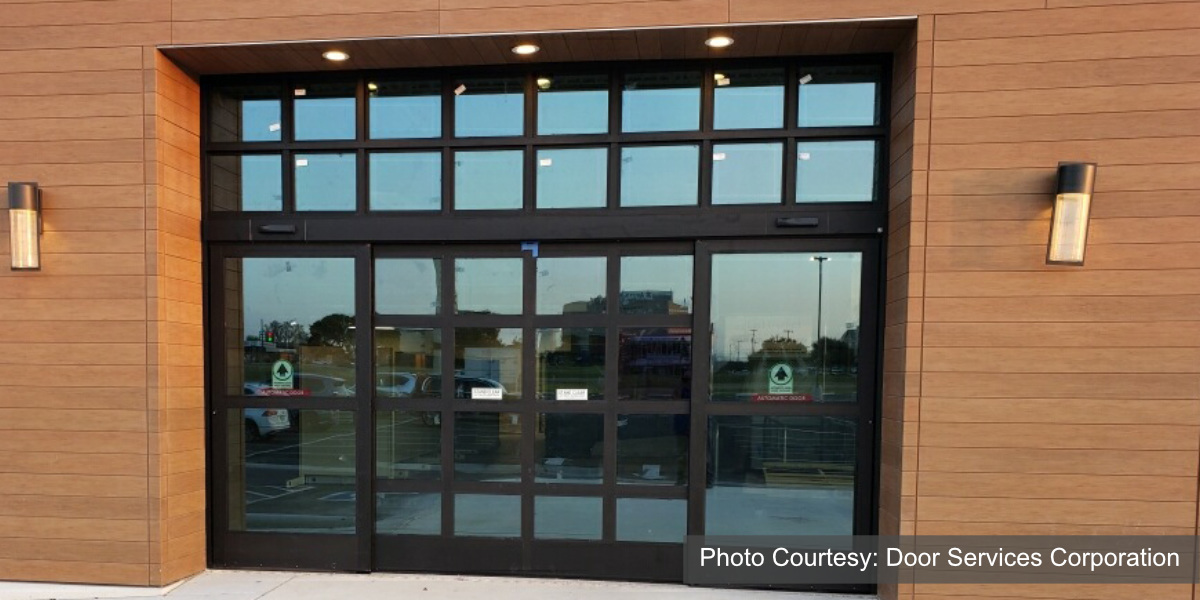
Most problems with automatic doors don’t happen by accident. They start with the wrong door type, the lowest-bid installation, or choices made without thinking through long-term use. Years later, maintenance teams are still managing complaints, downtime, and surprise failures — with no clear explanation to offer leadership.
The good news: most of this is preventable. The automatic doors you choose, how they’re installed, how they’re maintained, and how that information feeds back into future decisions — these are all connected. Get that chain right, and your entrances become something you barely have to think about. Get it wrong, and they become a recurring cost and a constant source of friction.
This guide covers all three stages: choosing automatic door solutions built for your real conditions, maintaining them intelligently once they’re in, and using what you learn to build a strategy you can actually defend.

Choose the Right Automatic Door for the Right Opening
On a plan, most openings look the same. In real life, they don’t. Some entrances handle a constant stream of people moving in both directions. Others accommodate carts, beds, deliveries, or gurneys. Some sit in quiet interior corridors. Others face wind, rain, and temperature swings at exterior doors on an exposed wall.
Choosing between automatic sliding doors, automatic swing doors, or another automatic door system that should start with how entrance is actually used — not what looks good on paper. A sleek glass storefront door load might seem right until you factor in wind in a tight vestibule. A swing door operator might seem fine until you see how often people arrive with mobility devices or bulky equipment.
The most effective projects begin with practical questions: How many people move through? At what times of day? With what kind of equipment? What happens to the flow of people if this automatic door goes down? That picture drives the choice of door type – whether that’s automatic sliding doors, a swing door, or even automatic revolving doors for high volume commercial buildings — so the entrance works with the building instead of against it.
Accessibility, safety, and security should also be designed from day one – not added after the fact. When these elements are layered on top of a finished installation, they often conflict with each other and with how the door was originally configured. Getting those decisions right up front avoids a lot of costly rework and repair down the line.
Don’t Underestimate What Installation Quality Actually Costs You
Good automatic door installation is more than hanging a header and turning on the power. The opening has to be prepared correctly so frames and supports are solid. The door frame must be square and properly anchored. Door operators and tracks have to be mounted and aligned precisely. Safety sensors need to be placed, aimed, and tested so they protect people without triggering constant nuisance stops. The control system must be configured for the actual environment — not just set to defaults.
On paper, two installation proposals can look nearly identical. One is a bit cheaper. It’s easy to feel like that’s the smart choice. What you often can’t see is how that lower price was achieved. If the installer cut corners on preparation, skipped tests, or rushed commissioning, the result is frequently a door that drags, fails to seal, bounces off safety stops, or wears out components ahead of schedule. Each of those issues becomes a repair call.
Teams that both install and service automatic doors see the full cost curve. Doors installed carefully and matched to their use need fewer emergency visits. Doors installed to win on price show up again and again in the service schedule. Over the life of the door, the “cheapest” installation often ends up being the most expensive one.
There’s also a practical advantage to working with a single partner across installation and access control. When one company installs your doors and a different company services them, recurring issues can turn into a blame game while your team deals with downtime. A single partner eliminates that friction. Using a single partner allows technicians to understand how each automatic door system was configured, what the environment demands, and what normal performance looks like — making troubleshooting faster and accountability clear.

Move From Emergency Repairs to a Maintenance Plan That Works
Even the best installation will eventually need attention. Automatic doors work hard every day. Hardware loosens, frames shift, sensors drift, and door operators may carry more load than anticipated. Without a clear maintenance plan, facilities teams tend to fall into a familiar cycle: an automatic entrance fails at the worst possible time, there’s a scramble for emergency repair, and a few weeks later the same thing happens again.
Living on emergency repairs might feel responsive, but it quietly drains time, budget, and credibility. Over time, people stop expecting doors to work. They build workarounds, avoid certain entrances, and accept unreliability as normal.
Smart service means more than fast response times. When certified AAADM technicians handle a repair, they should be looking beyond the immediate symptoms. They examine the full door system — door operator, frame, moving parts, motion sensors – and explain what failed, why it happened, and what it might signal going forward. That approach turns individual repair calls into real insight about the health of your entrances.
Preventative maintenance agreements take that a step further. Rather than treating every door the same, reputable door service providers build plans around actual usage patterns. ICU doors and high-traffic automatic sliding door systems at a hospital entrance need different attention than a manual door in a low-traffic corridor that opens twice a week. Some doors warrant inspection twice a year; others can run reliably on an annual schedule. The goal is to make sure the highest-risk automatic doors get the attention they deserve – before they fail.
Documentation is a non-negotiable part of that process. After every visit, you should be able to see clearly which door was serviced, what was found, what was done, and what’s recommended next. Over time, those records become a valuable resource — revealing which entrances have been stable and which have quietly consumed more budget than they should.
Use Your Service History to Make Better Decisions
Every repair call tells you something. A pattern of repairs for the same door tells you a lot. If an automatic sliding door has needed commercial door repair multiple times for similar issues, that’s a signal worth paying attention to. It may have been the wrong door type for that opening – perhaps a sliding door where a more robust solution was needed. It may have been installed without enough consideration for the traffic and conditions it would face. Or it may simply be reaching the end of a reasonable service life.
Doors that rarely show up in the log beyond scheduled maintenance are likely in good shape. Doors that generate frequent repair calls may be telling you that a different automatic door solution is needed.
Knowing when to stop repairing and start planning is one of the most valuable things a service partner can help you with. Sometimes a targeted hardware or sensor update, even something as focused as replacing a worn door closer or door handle, is enough to restore reliable operation. Other times, a new installation better matched to the opening, traffic, and environment makes more sense. Because some handle both, these recommendations come from real-world experience on both sides of the equation.
That continuity also makes capital planning more defensible. Rather than making budget requests based on memory or gut feel, you have a documented record for each automatic entrance: what was installed, how it has performed, what it has cost to maintain, and what the current recommendation is. That’s the kind of documentation that leadership can follow and finance can trust — whether you’re managing a single commercial building, a portfolio of office buildings, or facilities across government buildings and commercial applications.
A Practical Place to Start
You don’t need to audit your entire portfolio to begin building a better approach. Start with one building or one group of sites. Identify which automatic doors have been quietly reliable and which keep showing up in your repair history. That comparison usually makes the path forward clear: which doors need better access and service coverage, which are candidates for upgrade or replacement, and which are performing well and can stay on a lighter maintenance schedule.
Once you have that picture for one area, repeating the process elsewhere becomes faster and more straightforward — and you’ll have the documentation to back up every decision along the way.
Find a reputable and certified commercial door service company that is built to support every stage of this work. When they handle both installation and ongoing service, their recommendations connect both sides of the picture in a way a single-service vendor simply can’t. Install automatic doors matched to real-world use, maintain them with a service plan built around actual risk, and use repair history to decide when to adjust, upgrade, or request door service.
It’s a simple framework. But consistently applied, it’s the difference between entrances that are a constant source of friction and automatic doors that just work.
About Door Services Corporation: Your expert partner for pedestrian door service and installation, our company was built on quality products and long-term customer partnerships. We are a member of the American Association of Automatic Door Manufacturers. Our AAADM certified technicians have over 50 years of product knowledge. We service and repair all doors and windows models of all automatic door manufacturers. 24/7 emergency service is available at several branch locations throughout the U.S. and Ontario, Canada, to meet after-hours needs.